 Google
 HomeAdvisor
 Thumbtack
 Yelp
Yelp

The Best Overhead Door Opener Service in Greater Sacramento
The garage door opener is the most electrically and mechanically complex component in the garage door system — and the one that fails in the most varied and confusing ways. A door that won’t respond to the remote might have a dead battery. Or a failed receiver board. Or a rolling-code sync error. Or a tripped breaker. Or a failing drive gear. The diagnosis determines the fix, and the fix determines whether you spend $15 on a battery or $400 on a replacement unit. St. Mary’s Garage Door Services repairs and installs garage door openers for residential and commercial properties throughout Greater Sacramento — we diagnose the actual problem first and give you an honest assessment of repair versus replacement before any work begins.
Same-Day Service Available | 1,900+ Five-Star Reviews


Garage door opener types — which system is right for your property
Opener selection depends on the door type, the garage layout, the noise sensitivity of adjacent living space, and the features you want. Greater Sacramento’s range of housing — from 1980s single-car attached garages to new construction three-car bays to commercial roll-up doors — means no single opener type covers everything we install and service.
| Opener Type | How It Works — Best Application |
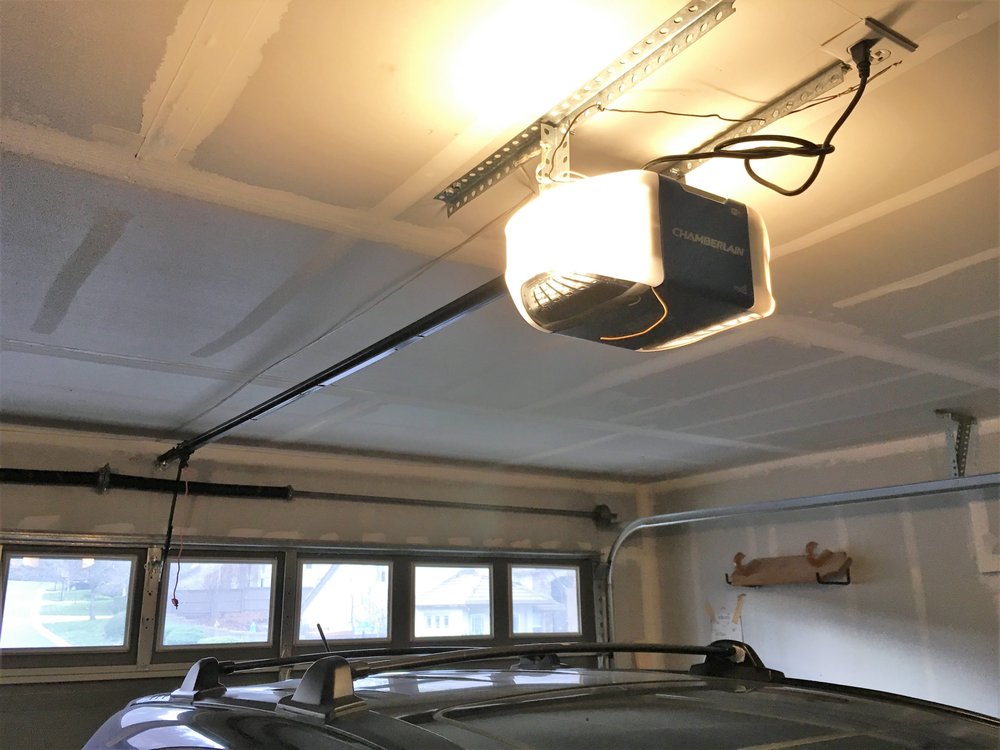
| Chain drive | A metal chain drives the trolley along the rail. The most common opener type in Sacramento’s 1990s and 2000s construction. Reliable and affordable. Louder than belt drive — not ideal when the garage is directly below or beside a bedroom. Most older openers we replace are chain-drive units. |
| Belt drive | Reinforced rubber or fiberglass belt instead of chain. Significantly quieter — the best choice for attached garages adjacent to living space. Slightly higher cost than chain drive. We recommend belt drive for most residential replacements in Greater Sacramento. |
| Screw drive | A threaded steel rod rotates to drive the trolley. Fewer moving parts than chain or belt systems. Louder than belt drive. Requires lubrication on the screw shaft. Less common in Greater Sacramento residential installations. |
| DC motor (vs. AC) | Most modern openers use DC motors with soft-start and soft-stop — the door accelerates gently rather than lurching to full speed, reducing mechanical stress on the spring system. DC motors run quieter and more efficiently than older AC motors. Any replacement opener we install uses a DC motor. |
| Jackshaft (side-mount) | Mounts on the wall beside the door rather than on the ceiling rail. Ideal for garages with low ceilings, cathedral ceilings, or when the ceiling space needs to be clear. Connects directly to the torsion spring shaft and turns the door by rotating the shaft. More expensive than trolley-style openers but the right tool for the right space. |
| Commercial and heavy-duty | Trolley operators for commercial sectional doors, coiling door operators for roll-up doors, and heavy-duty wall-mount operators for larger commercial openings. We service and install commercial opener systems throughout Greater Sacramento. |
| Smart / WiFi enabled | Standard opener plus a WiFi module allowing smartphone control, remote monitoring, and notifications. Most LiftMaster and Chamberlain openers can be upgraded to smart capability with a MyQ add-on module without replacing the full unit. New smart-ready openers include the module factory-installed. |
Common opener problems — diagnosis before repair
Most opener service calls fall into one of a small number of failure categories. Understanding the category determines the repair, and whether repair or replacement is the better economic decision.
Opener runs but door doesn’t move:
We measure the rough opening width, height, and header clearance — the space above the opening that determines track geometry and spring shaft positioning. A door ordered without accurate header clearance measurement may physically not fit the available spring and track space.
Door moves partway then reverses:
Auto-force limit set too low, or an obstruction is triggering the sensor. Test by manually checking door balance — if door doesn’t stay halfway open on its own, the spring needs adjustment before the opener force limit can be set correctly.
Remote stopped working:
Start with battery replacement. If new battery doesn’t help, try reprogramming the remote. If reprogramming fails, the remote receiver board on the opener may have failed — a repair that sometimes costs more than replacement depending on unit age.
Intermittent operation — works sometimes, not others:
Usually a failing circuit board capacitor, a loose wire connection at the motor terminals, or a receiver board with marginal sensitivity. Intermittent failures are difficult to catch during a service call — we check all wiring and connections and advise based on unit age.
Loud grinding or metal-on-metal noise:
Drive gear or sprocket wear. Common in chain-drive openers after 10+ years of operation. Usually repairable with a gear kit if the opener is otherwise sound. We carry common gear kits for LiftMaster, Chamberlain, Genie, and Craftsman.
Opener light stays on / off when it shouldn’t:
Logic board or light timer circuit failure. Minor issue — openers can function normally with this fault. Replacement of the logic board is often as expensive as a new opener if the unit is more than 8 years old.
Wall button works, remotes don’t:
Antenna, receiver board, or radio frequency interference issue. Check the antenna wire hanging from the opener head — if it is coiled or tucked up against metal, signal range drops dramatically. If extending the antenna doesn’t help, the receiver may need replacement.
When to repair vs. replace a garage door opener
Repair makes sense when the opener is under 10 to 12 years old, the failing component is a mechanical part with available replacement parts, and the repair cost is significantly below the cost of a new unit. For a drive gear replacement at $150 to $250 on a seven-year-old belt-drive opener, repair is the clear call. For a circuit board replacement at $200 to $300 on a fourteen-year-old chain-drive unit that already runs loud and doesn’t have smart capability, replacement with a current-generation opener makes more sense — you spend similar money and get a new unit with modern safety features and a warranty.
Safety features are worth noting. Openers manufactured before 2001 may not have the auto-reverse force sensitivity required by current safety standards. Older openers cannot be retrofit with MyQ smart modules. Rolling-code security technology — which changes the transmission code on every use to prevent code-grabbing — was introduced in the mid-1990s; older fixed-code openers are more vulnerable to replay attacks. We give you the honest comparison on repair versus replacement cost, performance, and safety.
Frequently asked questions about overhead door opener service in Greater Sacramento
My opener runs but the door doesn’t move. What’s happening?
The most common cause of an opener running with no door movement is a stripped drive gear. The motor is functioning and the drive shaft is turning, but the plastic gear on the motor shaft has stripped its teeth and is no longer engaging the chain, belt, or worm gear. Listen closely: if you hear the motor running smoothly with no grinding, the gear is likely stripped rather than the motor failed. A second common cause is a disconnected trolley — the emergency release cord was pulled and the trolley has not been re-engaged. Check the red cord hanging from the trolley carriage and re-engage the door to the trolley drive system if it has been released.
Can I add smart features to my existing opener without replacing it?
Yes, in most cases. LiftMaster and Chamberlain openers manufactured after 2011 are compatible with the MyQ smart home device, which plugs into the opener’s accessory port and adds WiFi monitoring and control via a smartphone app. Genie and Craftsman have similar add-on modules for compatible units. We check your specific opener’s compatibility during the service call and install the module at the same visit if your unit supports it. The upgrade typically costs $50 to $80 in parts. If your opener is older or not compatible, we discuss whether a full replacement with a factory-smart opener makes better sense economically.
How long should a garage door opener last?
Most quality residential openers are rated for 10,000 to 15,000 cycles — the same cycle rating as residential springs. At two daily uses that is approximately 14 to 20 years. In practice, opener lifespan is heavily influenced by whether the door is properly balanced. An opener working against an unbalanced door — one with a weak or broken spring — runs near its force limit on every cycle, accelerating motor wear and drive gear fatigue. Openers on well-maintained, properly balanced doors routinely exceed their rated life. Openers on doors that have never had spring maintenance tend to fail earlier.
My garage door opener is from the 1990s and it still works. Should I replace it?
If it works reliably, you do not need to replace it on a schedule. There are a few legitimate reasons to consider proactive replacement: fixed-code security (older than mid-1990s openers use fixed transmission codes that are vulnerable to code-grabbing devices), lack of auto-reverse sensitivity calibration to current standards, incompatibility with smart home integration, and parts unavailability if it does fail. If any of those factors matter to you, replacing it proactively with a current-generation unit makes sense. If the door works reliably and security and smart integration are not concerns, there is no urgency.
Can I install a garage door opener myself?
The electrical connection is straightforward on most residential openers — plug-in to a standard outlet. The mechanical installation — mounting the opener head to the ceiling, assembling the trolley rail, attaching the drive mechanism, and setting the force and travel limits — is within the capability of a competent DIYer. What is more complex is setting the spring system balance and auto-reverse force calibration correctly. An opener force limit set too high to compensate for an unbalanced door can fail to reverse on an obstruction that the auto-reverse is designed to detect. If your door’s spring system is in good condition and properly balanced, opener installation is a reasonable DIY project. If the spring system needs attention, we recommend a professional installation so both systems are addressed together.
Schedule overhead door opener service throughout Greater Sacramento
Call (916) 730-3491 for garage door opener repair or installation throughout Greater Sacramento. We diagnose first and give you repair versus replacement options before any work begins. Same-day service available. Serving residential and commercial properties across El Dorado, Placer, Sacramento, and Sutter Counties.
Overhead door service areas in Greater Sacramento
St. Mary’s Garage Door Services provides overhead door opener repair and installation for residential and commercial properties throughout Greater Sacramento. Select your city for local service and availability information.